
Blog
-
Who Manages the Money Managers?
Money affects everyone, but financial worries take different forms. From the struggle to meet daily…
-
Bookkeeping Tips for Small Businesses
Blog Effective bookkeeping is essential to running a successful small business. Accurate financial records help…

Effective bookkeeping is essential to running a successful small business. Accurate financial records help business owners monitor cash flow, control expenses, prepare for tax obligations, and make informed decisions.
At A1 Accountant LLC, we provide professional bookkeeping, QuickBooks support, and accounting services to help small businesses maintain organized financial records and understand their financial performance.
Essential Bookkeeping Tips
Here are seven practical bookkeeping tips to help your business stay organized and financially prepared.
1. Separate Business and Personal Finances
Open a dedicated business bank account and use it exclusively for business transactions. Separating personal and business finances simplifies bookkeeping, improves expense tracking, and supports accurate tax reporting.
Use a business credit card when appropriate, and ensure all transactions are recorded in the correct accounts.
2. Maintain Accurate and Timely Financial Records
Record income and expenses regularly rather than waiting until the end of the month or tax season. Delayed bookkeeping can lead to missing receipts, unrecorded transactions, and inaccurate financial reports.
Maintain supporting documentation for business purchases, customer payments, invoices, and reimbursements. Consistent recordkeeping makes financial information easier to verify and review.
3. Use QuickBooks to Streamline Bookkeeping
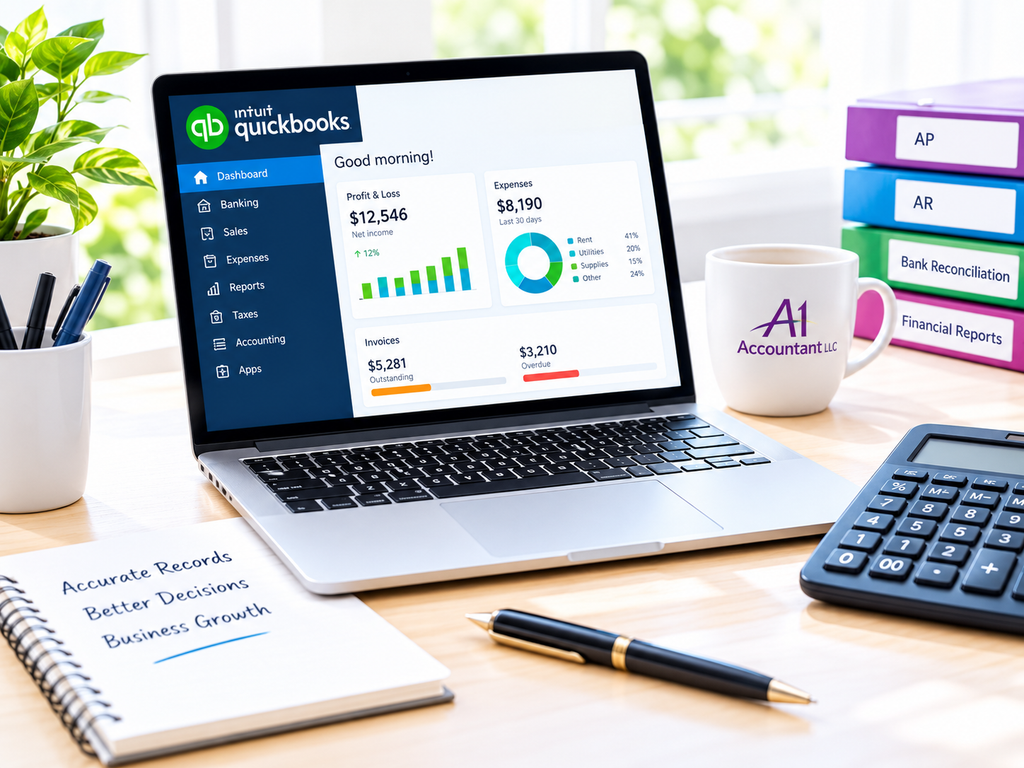
Accounting software such as QuickBooks Online or QuickBooks Desktop can help small businesses organize transactions, track income and expenses, manage invoices, and generate financial reports.
To get the most from your accounting software:
- Categorize transactions using an appropriate chart of accounts.
- Review bank-feed transactions before accepting them.
- Match downloaded transactions to existing records to avoid duplicates.
- Reconcile bank and credit card accounts regularly.
- Review reports for unusual balances or missing transactions.
Accounting software is most effective when transactions are entered accurately and reviewed consistently.
4. Reconcile Bank and Credit Card Accounts Monthly
Bank reconciliation compares your accounting records with your bank statement to confirm that transactions have been recorded correctly.
Monthly reconciliation helps identify duplicate entries, bank fees, missing deposits, unauthorized transactions, and outstanding checks.
Credit card accounts should also be reconciled to verify expenses and outstanding balances. Investigating discrepancies promptly helps maintain reliable financial records.
5. Monitor Cash Flow and Accounts Receivable
Profitability does not always mean sufficient cash is available to pay bills. A business may report a profit while experiencing cash shortages because customers have not paid their invoices.
Review outstanding customer balances, follow up on overdue invoices, and monitor upcoming expenses. A cash flow forecast can help you anticipate financial needs and plan for payroll, rent, taxes, and other obligations.
6. Review Financial Reports Regularly
Financial reports provide valuable information about your business’s performance.
Three important reports include:
- Profit and Loss Statement: Shows revenue, expenses, and net income over a specified period.
- Balance Sheet: Shows assets, liabilities, and equity at a particular date.
- Statement of Cash Flows: Shows cash generated and used by operating, investing, and financing activities.
Review these reports monthly when practical. Comparing current results with prior periods and your budget can help identify trends, control expenses, and support better business decisions.
7. Prepare for Tax Season Throughout the Year
Good bookkeeping makes tax preparation more efficient. Maintain organized records of deductible business expenses, payroll, contractor payments, equipment purchases, and other relevant transactions.
Keep supporting documentation and reconcile accounts before year-end. Consult a qualified tax professional about applicable filing requirements, deductions, and record-retention obligations.
When Should You Consider Professional Bookkeeping Services?
As a business grows, bookkeeping can become more time-consuming and complex. Professional assistance may be helpful when you have a backlog of transactions, unexplained account balances, overdue reconciliations, or financial reports that are difficult to interpret.
A professional bookkeeper can help organize records, reconcile accounts, maintain QuickBooks, and prepare financial reports for management and tax professionals.
Build a Stronger Financial Foundation
Accurate bookkeeping is more than a recordkeeping task. It provides the financial information business owners need to understand performance, manage cash flow, and plan for growth.
A1 Accountant LLC provides bookkeeping, QuickBooks support, account reconciliation, and financial reporting services for small businesses and nonprofits in Washington, DC, Virginia, and Maryland.
Contact us to discuss your bookkeeping needs and learn how organized financial records can support your business.
A1 Accountant LLC
Website: https://a1accountant.com
Email: info@a1accountant.com